Why multifamily remains a core investment strategy

Multifamily real estate continues to stand out as one of the most resilient, income-producing asset classes in the U.S., supported by durable demand, structural housing undersupply and institutional-quality cash flow characteristics.
Passive wealth creation
Professionally managed multifamily investments offer:
- Consistent income distributions
- Tax advantages (e.g., depreciation, cost segregation and bonus depreciation)
- Access to institutional-quality real estate without active management
Structural demand tailwinds
- The U.S. faces a multi-million-unit housing shortage, with approximately 3.6 million homes needed to meet demand.[1]
- Demographics remain highly supportive:
- Millennials and Gen Z are entering peak renting years.
- High home prices and mortgage rates are delaying homeownership.[2]
- Multifamily demand remains strong, with positive net absorption and continued renter household formation.
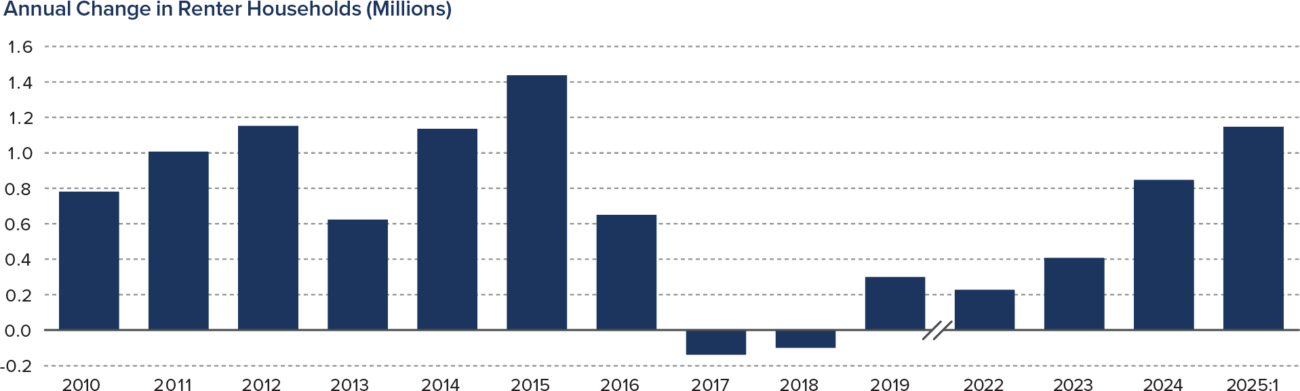
Note: Estimates for 2020 and 2021 are omitted due to data collection issues experienced during the pandemic.
Source: “2025 State of the Nation’s Housing,” Joint Center for Housing Studies of Harvard University, 2025.
Potential for resilient income & predictable cash flow
- Residential assets feature the lowest volatility and nearly the highest average annualized returns of the majority of property types.[3]
- Rental housing benefits from:
- Short lease durations, meaning an ability to reset rents to market
- A diversified tenant base, meaning reduced occupancy risk
- Absorption is expected to overtake new deliveries in 2026, setting the stage for rent growth.[4]
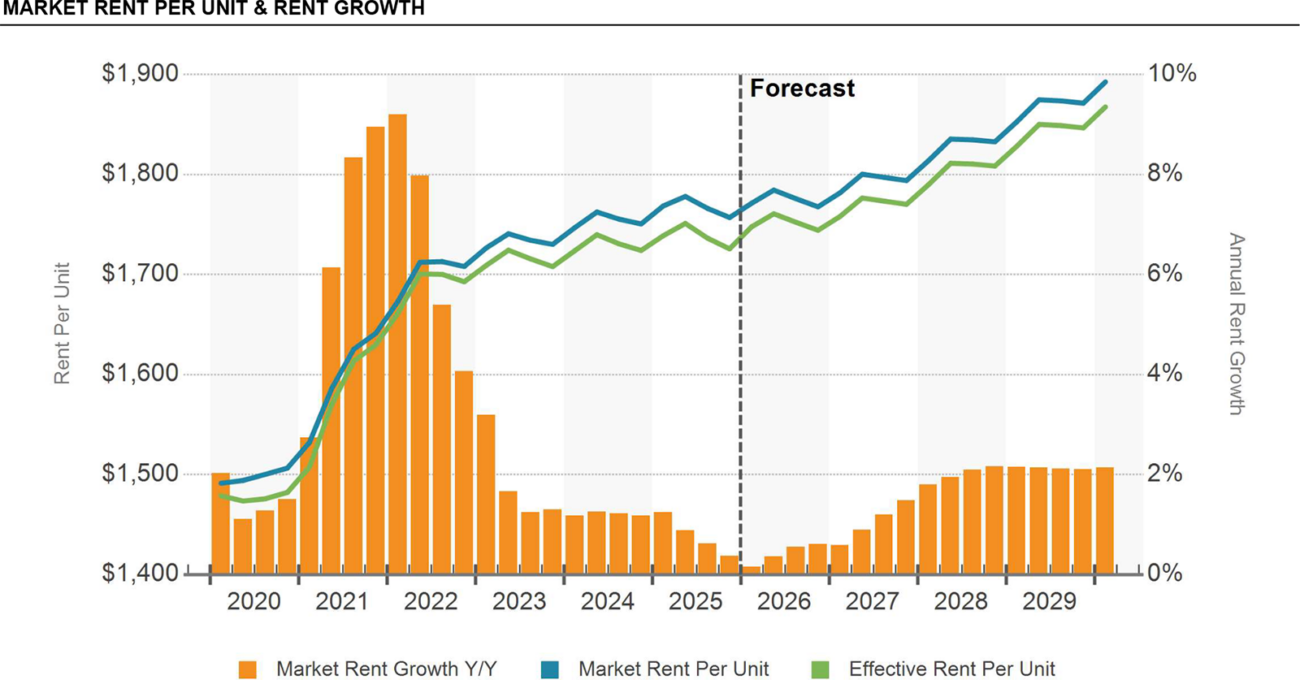
Source: “United States Multi-Family National Report,” CoStar, 2026.
Institutional stability
- Multifamily is a demonstration of “essential-use demand.” Housing is non-discretionary.
- The construction pipeline has contracted approximately 50%, from 1.18 million units under construction in Q1 2023 to 578,000 units under construction in Q4 2025.[5]
- These dynamics support long-term occupancy and pricing power.
The bottom line
Multifamily real estate investment offers a compelling combination of structural demand, resilient cash flow and operational upside, positioning it as a powerful vehicle for long-term, passive wealth creation in an uncertain economic environment.
Explore Capital Square’s latest multifamily offerings and discover how you can invest in income-producing real estate designed for long-term performance.
Disclosure: Securities offered through WealthForge Securities, LLC, Member FINRA/SIPC. Capital Square and WealthForge Securities, LLC are separate entities. There are material risks associated with investing in DST properties and real estate securities including illiquidity, tenant vacancies, general market conditions and competition, lack of operating history, interest rate risks, the risk of new supply coming to market and softening rental rates, general risks of owning/operating commercial and multifamily properties, short-term leases associated with multifamily properties, financing risks, potential adverse tax consequences, general economic risks, development risks, long hold periods, and potential loss of the entire investment principal. Past performance is not a guarantee of future results. Potential cash flow, returns and appreciation are not guaranteed. IRC Section 1031 is a complex tax concept; consult your legal or tax professional regarding the specifics of your particular situation. This is not a solicitation or an offer to see any securities. Please read the Private Placement Memorandum (PPM) in its entirety, paying careful attention to the risk section prior to investing. Diversification does not guarantee profits or protect against losses. Private placements are speculative and illiquid.
[1] Peter Linneman, “The Linneman Letter,” Volume 25: Issue 1, Spring 2025.
[2] CBRE Research, CBRE Econometric Advisors, U.S. Census Bureau, Realtor.com®, FHFA, NAR, Oxford Economics, Q2 2025.
[3] “Annual Returns by Property Sector and Subsector: 1994 – 2025,” NAREIT, 2026.
[4] “United States Multi-Family National Report,” CoStar, 2026.
[5] Ibid.
