Q1 2026 Investment Insight: Build for Rent’s Acceleration (part 2)
Part two of this Q1 2026 investment insight series continues the behind-the-scenes discussion about Build for Rent (BFR) and Capital Square’s position in the industry with our executive vice president of acquisitions, Jorge Figueiredo, and vice president of acquisitions, Bennie Su.
(If you missed it, discover part one.)
Key Moments:
- Who are the BFR market participants? (0:00)
- What is Capital Square’s build-for-rent track record? (jump to 1:27)
- What have been the agency financing trends with BFR? (jump to 3:29)
- What are the synergies between managing multifamily and managing Build for Rent? (jump to 6:28)
- What are the latest build-for-rent metrics around supply and demand? (jump to 8:38)
- What’s next for Capital Square in the BFR space? (jump to 10:55)
Approximate Transcript:
Jorge: Let’s talk about capital markets for a little bit. We are focused on providing this type of investment in a build-for-rent (BFR) property, an institutional quality asset, to retail investors – people that otherwise wouldn’t have that ability. Who else is out there? Who are we seeing in the space? Who are the market participants? And when we look at our own portfolio, when we think about an exit strategy, what’s the buyer pool look like for us? What’s our potential for success if we want to go full cycle with a property?
Bennie: There’s been a lot of great institutional interest in Build for Rent, both from the equity perspective and the debt side. On the equity side, traditional multifamily developers, they’re experts in dealing with zoning entitlements, navigating difficult situations with the city governments, putting the shovel in the ground, and building big, beautiful buildings in tandem with architects and general contractors (GCs), and so they’re taking their expertise and moving it into this asset class. Sunstone Two Tree is a great partner of ours, and they are very well respected, best-in-class in what they do, both on the multifamily side and now on the Build for Rent side, too.
In terms of real estate investors, as we mentioned, we’re one of them. Capital Square launched our build-for-rent platform three years ago. In the course of that time, we’ve been very busy. We’ve closed over a dozen deals within this space, over half a billion dollars of gross asset value (GAV) across transaction types: stabilized, forward and development.
And other participants, such as Blackstone, have put a lot of money in here. In 2024, they took Tricon private with a big build-for-rent pipeline behind it for $3.5 billion. Brookfield acquired Divvy Homes earlier in 2025 for $1.5 billion, where they bought the platform and the underlying 7,000 homes as well. And so, there’s a lot of very interested equity participants in the build-for-rent space.
On the debt side, there’s tremendous amount of interest here. And because of this, spreads are actually at record lows. It’s very competitive. There’s a lot of powder out there for debt providers, and this is bifurcated between agencies, insurance companies and private debt funds too.
On the agency side, both from Fannie and from Freddie, they have a cap of $150 billion a year that they can allocate to this particular asset class. So that’s a lot of money.
And from the insurance side, they always have plenty of money to put to work and put in safe assets as they exercise their asset liability management and debt funds. You’ve probably heard the phrase “the golden age of private credit,” right? And that’s because they’ve raised a tremendous amount of money as base rates went from 0% to over 5% and they need to put that money to work. It’s extremely competitive. When we were raising the [mezzanine loan] last year, we got seven term sheets. It’s very competitive. A lot of participants in this asset class.
I know that Capital Square is a big consumer of agency financing. What trends have you seen there? Particularly, recently, we closed a deal two months ago, and we closed that at max leverage at 100 basis points, spread over the 10-year treasury. What trends have you seen from being a participant in the agency programs?
Jorge: We’ve done over $2 billion in agency debt over our lifetime, mostly with conventional multifamily, and as you noted, we closed a recent property with a Fannie Mae loan with terms that were pretty much comparable to conventional multifamily. The trend I’ve seen is that this is less of a buzzword asset class now, and people just have a real understanding of the nuances and the differences but in a very positive way that has driven the agencies more toward the product.
I think several years ago, there were more question marks. The trends have now allowed them to just underwrite those BFR deals, again, a lot more like a multifamily, a conventional deal. They have a better understanding. We have better track record. We have performance metrics that we can point to. And now those limitations are a lot more specific, like they won’t lend to a scattered site property, but that’s okay with us, because that’s not our focus. That wouldn’t really work for what we do – primarily on the acquisition side, on the stabilized size – which is to offer these properties for people looking for a 1031 exchange. That net scattered site portfolio just wouldn’t work from an identification, from an exchange perspective. But more importantly, it allows us to tap into agency debt, which typically is the best fit for what we do under the DST platform to provide that 1031 exchange solution.
So, very positive from our side, and we look to do a lot more in the future – tapping into the best debt available, the lowest spreads available – so that our investors can benefit from that high-quality debt and a high-quality real estate asset class.
Bennie: We’re also getting really great construction financing. At Capital Square, we’re active on the development side for Build for Rent too. So, what we do there: we love to build assets that we can’t necessarily acquire, and we’re also being part of the solution to the housing crisis that we see in the U.S.
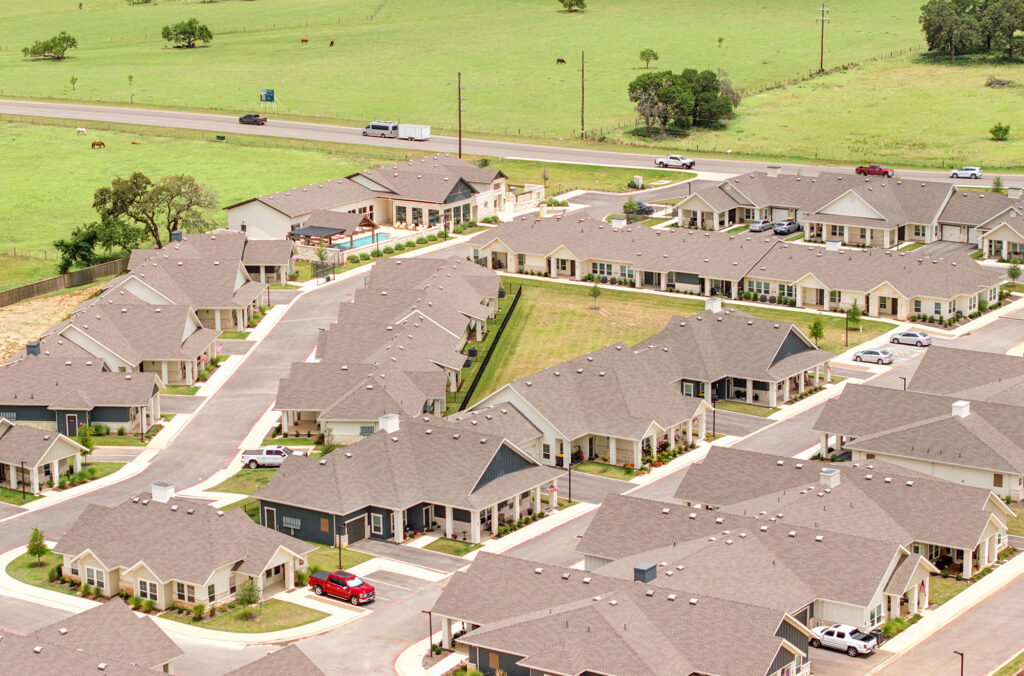
The developments that we create are best-in-class in terms of the amenities, that build quality. It’s got the swimming pool, the fitness center; it’s got everything that you can ask for, which is really great for our resident profile.
Speaking of those residents, Capital Square is a big investor in multifamily, and three years ago, we launched a property management platform called Capital Square Living or CSL. What synergies do you see between managing multifamily and Build for Rent? Is it really different, or can the multifamily operators really know how to operate Build for Rent?
Jorge: Same, same, but different, right?
I think there are a lot of lessons to learn when you don’t know the product very well, but overall, you take best practices from other operators, and you adjust. It’s understanding the demographic and understanding what residents truly want out of their experience. It can be perhaps a little more hands-on – making sure that the service provided and the upkeep of the property is there – because we want residents to treat the home that they’re renting from us like they own it. That’s going to give us the best financial results. So, it’s paying attention to those nuances, to the demographic, and responding accordingly.
Bennie: When I entered the real estate space in 2021, it was questionable whether Build for Rent would stay as an asset class. And over the last four or five years, I think it’s really tremendous in terms of how it’s evolved as an asset class, even through the brokerage networks.
A lot of the interactions that we have with the big brokers, like CBRE or JLL, it’s really folded into their multifamily space. A lot of investors and a lot of brokers are viewing BFR almost as a cousin or sub-asset class within traditional multifamily. It’s very similar in terms of how it operates, to a certain extent, and you see multifamily operators and property managers being property managers for Build for Rent too, such as Greystar and CSL, which is doing an excellent job for the products in our portfolio. But it’s really great to see the evolution of that asset class over such a short period of time.
Jorge: Agreed. And again, the theory is being proved correct that this is a great product: a great solution for the housing crisis that we have in the U.S. but also, at the same time, lending itself to a great investment property as well.
Bennie: As we look forward, I think that a lot of supply has come, and it’s being absorbed extremely well. When we look when base rates were at zero post-COVID, it really fueled the boom for building. You had peak starts right after COVID, and when you compare those starts relative to today, that’s fallen 50%. Compared to last year, it’s fallen by over 20%. All the deliveries that are happening, they’re being absorbed because of the tremendous demand that we’re seeing in the types of markets that we’re investing in.
Going forward, what do you think is going to happen as it relates to rent growth and occupancy, very important metrics for Build for Rent?
Jorge: I think that’s a very good point on the supply side. On the demand side, we obviously don’t know what interest rates are going to do, but the truth is – or at least the expectation is – we’re not going back to zero, right? So that main driver for renter demand in the BFR space, of that delta between owning versus renting a home, we don’t see it coming back to the historical norm anytime soon. We expect to continue to see it elevated. I think that will continue to drive the demand.
And again, it’s a new product. It’s the quality that you’re looking for. It’s the home-like product that you’re looking for, if you are a young professional with a kid on the way, and you want a little more separation from your neighbor; you want a yard; you want a good school. Whatever those reasons might be, it just means more demand for this asset class, and when the supply side stabilizes, I think that bodes really well for the future: higher occupancies, being able to lease up properties faster and continue in a rent-growth environment going forward. So, I think the outlook is really good for this asset class.
Bennie: That’s great. When you see the Capital Square portfolio today, it’s tremendous what the firm has done over such a short period of time. What are you most excited about in the build-for-rent space? And where do you see Capital Square moving forward as it relates to the asset class?
Jorge: Scale. I think the one of the few challenges with Build for Rent is that they tend to be smaller properties. In the conventional multifamily side, our average property is over 250 units, probably close to 300 units. It’s easier to manage that on site when you have that many units to make up for the cost of staffing the property. One of the challenges we see is with a 100-unit property, it becomes more difficult to operate. You can’t have one person alone working an office for a property. It just doesn’t work because they need time off; they need vacation.
So typically, a larger property allows you to operate more efficiently from a staffing standpoint. On a build-for-rent property, call it between 50 and 100 units, which has been historically our acquisitions, it’s a little bit harder to get those efficiencies. But with our management company scaling, we’re able to share some staff, and as we continue to grow the portfolio, we’re going to see more opportunities to rein in those costs even further, and again, continue to gain experience, not just operating those properties, but gaining from some of the scale that we’ll have as we build out the portfolio in the markets that we talked about, where we continue to see very positive supply and demand trends and where we want to grow.
Bennie: Well, it’s been a really great conversation. I definitely learned a lot from you, and it’s been really tremendous to see what Capital Square has done in such a short period of time in a nascent asset class.
With all the tremendous tailwinds that we’re seeing from a fundamental perspective, it’s going to be really exciting to see what Capital Square will continue to do in the future for Build for Rent.
Jorge: Likewise, and I’m really excited for what the future holds.
The future of Build for Rent starts here.
At Capital Square, we believe the Build for Rent asset class is positioned for growth. Discover how our open BFR offerings might fit your 2026 goals. Contact our team today.
Disclosure: Securities offered through WealthForge Securities, LLC, Member FINRA/SIPC. Capital Square and WealthForge Securities, LLC are separate entities. There are material risks associated with investing in DST properties and real estate securities including illiquidity, tenant vacancies, general market conditions and competition, lack of operating history, interest rate risks, the risk of new supply coming to market and softening rental rates, general risks of owning/operating commercial and multifamily properties, short-term leases associated with multifamily properties, financing risks, potential adverse tax consequences, general economic risks, development risks, long hold periods, and potential loss of the entire investment principal. Past performance is not a guarantee of future results. Potential cash flow, returns and appreciation are not guaranteed. IRC Section 1031 is a complex tax concept; consult your legal or tax professional regarding the specifics of your particular situation. This is not a solicitation or an offer to see any securities. Please read the Private Placement Memorandum (PPM) in its entirety, paying careful attention to the risk section prior to investing. Diversification does not guarantee profits or protect against losses. Private placements are speculative and illiquid.